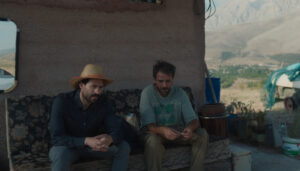
Khatami’s self-description as an orphan or nomadic filmmaker, together with the film’s Canada–France–Poland co-production context, positions cinema as a space of relative freedom—one where the work need not “answer” in advance to national expectation or identity branding. This stance also underwrites the film’s refusal to be reduced to an “ethnic” label as well as a genre film: even as it incorporates Turkish cultural textures with remarkable density, it aims at something more structurally legible—a study of how violence becomes tradition, how familial memory hardens into an inheritance, and how form itself (tableaux and close-ups; shifts from brightness to darkness; the strategic withholding of a guiding musical score) can render that inheritance visible without presuming to resolve it as a linear storyline.
