by Hudson Moura
Written and directed by Alejandro González Iñárritu, Digger is an intentionally awkward, excessive, and highly theatrical political satire about capitalism, environmental destruction, and the narratives powerful people construct to maintain control. Visually extravagant and verbally relentless, the film establishes excess as both its aesthetic principle and its narrative method. Tom Cruise plays Digger, a grotesque oil magnate whose larger-than-life presence immediately establishes this world of absurdity and exaggeration. Iñárritu initially immerses us completely in Digger’s universe, only to gradually reveal that what we are watching is itself a performance.
The film announces this instability from its opening image. We seem to be looking at an idyllic pastoral landscape, accompanied by birdsong, until we realize that the landscape is actually an image displayed on the screen that serves as the window in Digger’s bedroom. It is an effective introduction to a film obsessed with the difference between reality and representation. Digger himself is more than a businessman: he is presented almost as a hunter, surrounded by animal heads and trophies in a house that turns wealth, domination, and violence into décor. Cruise’s appearance is equally artificial. His face and body have been radically transformed by prosthetics, making him deliberately plastic, ugly, and almost monstrous.
Visually, Digger frequently recalls the satirical universe of Joel and Ethan Coen. Iñárritu uses extreme close-ups, low angles, distorted framing, and Dutch angles that deform both people and spaces. Characters become physically grotesque, while the environment itself seems unstable. That resemblance becomes even stronger with John Goodman as the President of the United States, another enormous, obsessive, larger-than-life personality driven by the desire to control everything around him. It is difficult not to see echoes of Donald Trump in the character, although Iñárritu pushes him into the exaggerated register of political farce.
The crisis driving Fossil Fools—the play within the film—is an accident involving Digger’s oil operations in Greenland that threatens catastrophic consequences for Europe. Ganesh, played by Riz Ahmed, is the scientist attempting to explain the danger, while government, corporate, and political figures scramble to manage the disaster. Yet the central issue quickly becomes not only what has happened, but who gets to control the narrative about what has happened. Information is constantly being withheld, reformulated, or delivered too late.
This becomes one of the film’s principal narrative devices. Again and again, someone approaches another character with urgent information about something that has occurred offscreen. The pattern resembles the familiar “I have good news and bad news” structure: a revelation seems catastrophic, only for the messenger to explain that this was not even the bad news. Because we discover these events alongside the central character, Digger creates a perpetual state of escalation. It is an effective comic mechanism, although its repetition eventually becomes somewhat exhausting.
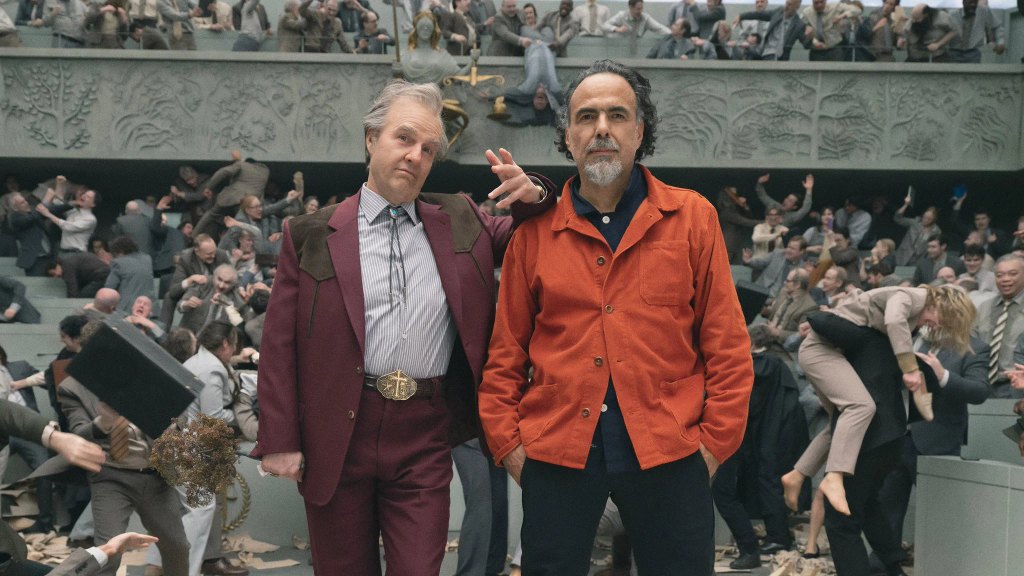
Then Iñárritu complicates everything by revealing that this apocalyptic corporate drama is actually a theatrical rehearsal. Cruise is Curtis Markson, an actor struggling to inhabit Digger only hours before the premiere of a new production of Fossil Fools, a play now celebrating its twentieth anniversary. Curtis is distracted by a much more immediate anxiety: his daughter has disappeared during a flight, and his fear for her continually interrupts his attempt to surrender himself to the role. The film therefore creates a discourse inside another discourse: an actor performs a businessman who has helped exploit society and destroy the planet, while the actor’s own private crisis keeps breaking through the artificial world of the stage.
This is where the film’s theatrical conception becomes particularly interesting. Iñárritu creates such an immersive mise-en-scène around Fossil Fools that we repeatedly move between the rehearsal and backstage without completely leaving Digger’s world. For viewers who love theatre, there is considerable pleasure in the way Digger explores acting, rehearsal, performance, scenery, and the unstable boundary between a character and the performer embodying him. The situation becomes more layered when we learn that Digger’s story is substantially based on a real businessman and that the production is being mounted by his nephew, played by Jesse Plemons. Performance, family history, exploitation, and representation become increasingly entangled.
The theatrical structure also introduces an important generational dimension. Fossil Fools is not simply representing a catastrophe; it is transforming that catastrophe into historical memory for a generation already living with its consequences. The people responsible for the destruction of the past are reconstructed as grotesque theatrical figures, turning trauma into satire and political responsibility into performance. In this sense, Digger also asks how one generation represents another: whether caricature can reveal a historical truth that psychological realism might soften, and how catastrophe itself eventually becomes representation, entertainment, and cultural memory.
The problem is that the same excess that makes this theatrical world coherent also makes the film tiring. Cruise’s prosthetic transformation makes perfect sense within the grotesque farce of Fossil Fools, but keeping him inside this aggressively artificial body for so much of the film becomes difficult to engage with emotionally. The nonstop dialogue, exaggerated performances, visual distortions, and relentless escalation rarely allow the film—or the spectator—to settle. Iñárritu clearly wants everything to feel excessive because the world he depicts is itself excessive, but intentional excess can still become exhausting.
At its centre, however, is a serious political question. Digger is an apocalyptic fable about climate change and the generation whose economic choices have left the planet in an increasingly precarious condition. There is a particularly funny moment when Markson complains about how awkwardly and absurdly Digger is portrayed in Fossil Fools, only for the young director to remind him that the play is a satire. The exchange becomes even more ironic because the satire is being performed by actors who themselves belong to the generation the play is implicitly confronting.
Although Iñárritu’s film focuses on climate catastrophe as an immediate and increasingly tangible reality, it arrives at a moment when public anxieties about humanity’s future have expanded considerably. Artificial intelligence has rapidly become another major source of uncertainty and fear, generating debates about employment, human agency, political power, and even the possibility of existential risk. In that context, Digger’s apocalyptic imagination can occasionally feel anchored in an earlier moment, when climate change occupied a more singular position within visions of planetary catastrophe. This does not make the film’s environmental warning any less urgent; rather, it reveals how quickly our collective imagination of what might threaten humanity continues to evolve.
Digger is ultimately a formally audacious but exhausting theatrical satire, and that contradiction seems inseparable from Iñárritu’s project. Its grotesque bodies, distorted images, dutch angles, relentless dialogue, and constant escalation create an impressively immersive world in which theatre, reality, and political spectacle repeatedly collapse into one another. Yet the film’s excess can also become its limitation: what is initially funny, inventive, and unsettling gradually feels overextended. Its environmental warning remains urgent, even if its apocalyptic imagination sometimes seems rooted in an earlier political moment.
Digger becomes not simply a film about how power constructs narratives to control reality, but about what happens when subsequent generations seize those narratives back—turning catastrophe into theatre and the powerful people responsible for it into grotesque figures of historical memory.
 Rating: 3.7/5