by Hudson Moura
With Alien Earth, creator and director Noah Hawley boldly extends the legacy of Dan O’Bannon and Ronald Shusett’s original Alien universe, offering a series that not only respects the franchise’s foundational horror and speculative ethos but dares to expand it—geographically, genetically, and philosophically. Distributed by Disney+ and produced by FX and Scott Free with the support of multiple international jurisdictions, including strong contributions from Canada (Quebec, Ontario, and British Columbia), Thailand, Australia, and New Zealand, the series exemplifies both transnational storytelling and the continued global fascination with the Alien mythos.
Divided into two primary narrative axes—one aboard a research spaceship and the other set on Earth—the eight-episode arc reactivates the franchise’s core themes of contamination, technological hubris, and the boundaries of humanity, while also injecting new dramatic and conceptual mutations. Almost half of the series, set in deep space, retains the claustrophobic dread that defined Ridley Scott’s original and James Cameron’s action-infused sequel. The spacecraft becomes the site of multiple contamination events, involving not just a single alien specimen but a rapid proliferation of forms (the “eye” is my favourite). The familiar beats are here: mistrust among crewmembers, betrayal by the corporate apparatus, and the slow, horrifying realization that the enemy is not only within but multiplying.
A Bold Mutation of the Franchise’s DNA
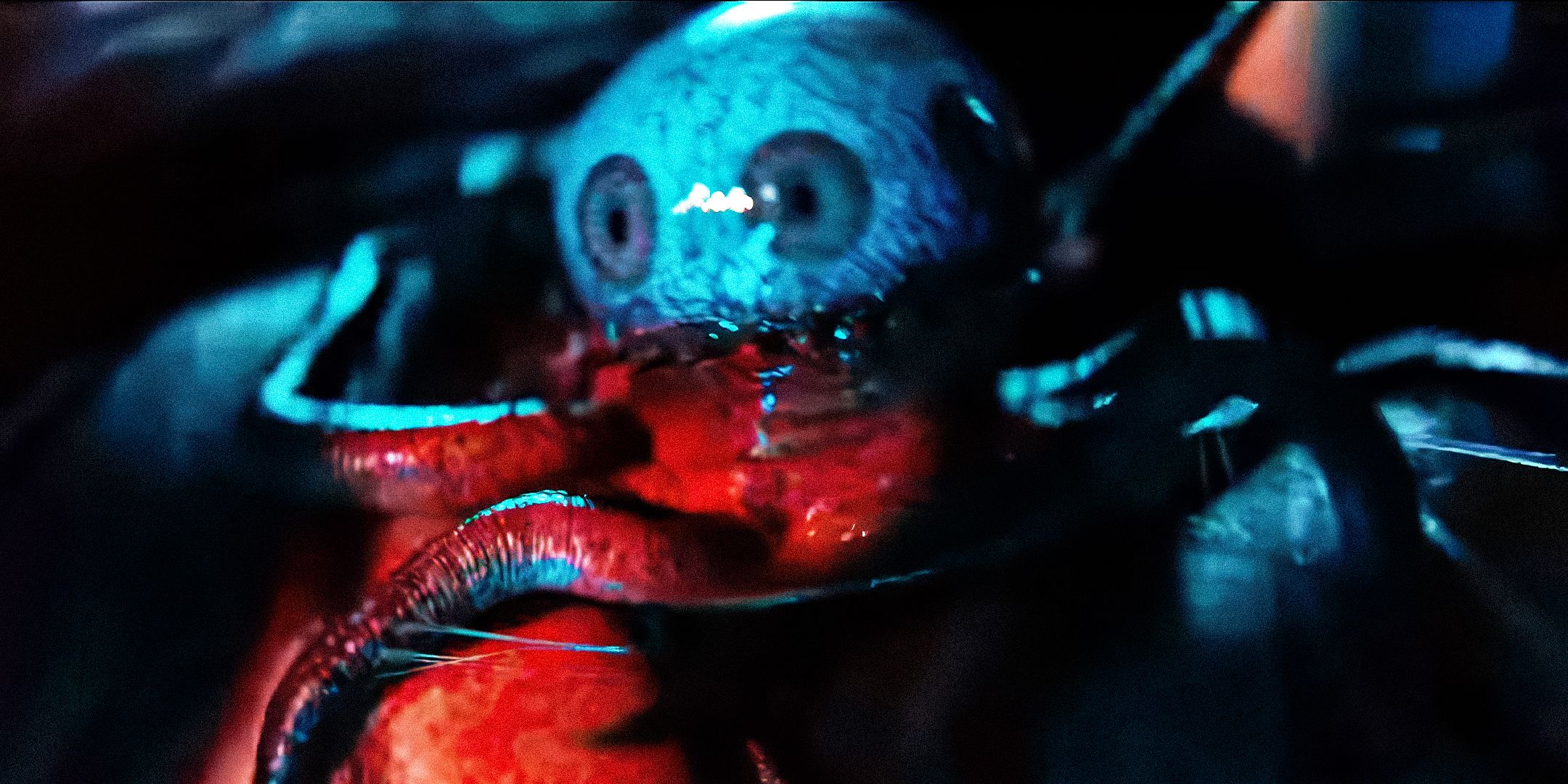
Yet it is the Earth-based sequence that truly signals Hawley’s ambition. This is where Alien Earth transcends homage and becomes a substantive addition to the mythos. Revisiting the subplot of cyborgs and bio-hybrids first hinted at in earlier franchise entries, the terrestrial episodes plunge into deeper questions of identity, sentience, and species hybridity. These developments are not mere narrative add-ons—they are philosophically weighty and politically resonant, especially in today’s climate of techno-anxiety and bio-surveillance. In an era still haunted by Trump-era protectionism and ongoing debates around AI, border control, and biomedical ethics, Alien Earth touches a raw contemporary nerve.
The inclusion of a new communication system between alien and human entities marks a particularly daring conceptual turn. Without revealing too much, it suffices to say that this innovation opens up speculative possibilities about language, cognition, and cross-species empathy—territory rarely explored in the more action-driven installments of the franchise.
Throughout, Hawley maintains a deft balance between genre expectations and narrative invention. The aesthetics are unmistakably rooted in retro-futurist design, yet the series never slips into mere pastiche. Rather, it oscillates between grim industrial horror and moments of haunting beauty. The performances—especially by the Earth-bound cast—add emotional texture to a story that could easily have been lost in effects-driven spectacle.
Having seen six of the eight episodes, I can already affirm that Alien Earth is a worthy and often thrilling extension of the Alien universe. The final two episodes will determine just how far this reinvention is willing to go, but even now, the series stands as one of the most creative and intellectually provocative additions to the franchise in decades. It is both a return and a departure—a series that remembers where it came from, but is unafraid to ask where we are going.
Full Disclosure: I am a long-time fan of the Alien franchise—Ridley Scott’s Alien and James Cameron’s Aliens rank among my all-time favorite science fiction films. As such, my expectations going into Alien Earth were especially high. A project like this had the potential either to deeply satisfy through meaningful narrative and aesthetic expansion or to disappoint through the decharacterization of what makes this universe so compelling. I can safely say that Alien Earthexceeded my expectations. It honors the spirit of the franchise while boldly evolving its mythos in ways that feel both fresh and thematically rich. (4.5/5)
FX’s “Alien: Earth” premieres with two episodes on Tuesday, August 12 at 8pm ET on FX and on Disney+ in Canada.