by Hudson Moura
Written and directed by Gabriel Martins, On Behalf of My Son (Vicentina Pede Desculpas) begins with a deceptively simple gesture: Vicentina travels across the city, going from home to home to apologize to the families of people whose lives were destroyed by her son. From this premise, Martins constructs an extraordinarily dense drama about grief, responsibility, guilt, forgiveness, and the limits of human connection. The Portuguese title is particularly significant—Vicentina Pede Desculpas, literally “Vicentina apologizes”—because the act of asking forgiveness is not merely the narrative device that moves the film forward; it is its moral and emotional centre.
Yet the film immediately complicates that gesture. What exactly is Vicentina apologizing for? One of the people she encounters asks the question directly: does she believe that what her son did is somehow her responsibility? Is she guilty because she raised him? Can a mother apologize for another person’s actions simply because that person is her child? Martins never reduces these questions to a clear moral equation. Instead, every encounter forces Vicentina—and the viewer—to reconsider what apology might mean when nothing can repair what has happened.
This structure gives the film its emotional force. Each visit produces a different response. Some people receive Vicentina with anger, others with disbelief, awkwardness, despair, denial, or a degree of understanding. Some refuse to meet her at all. Nobody seems to know exactly what one is supposed to say in such circumstances, and Martins is particularly sensitive to that awkwardness. The encounters are rarely organized around grand dramatic speeches. People hesitate, smoke cigarettes, sit together, struggle for words, or fall into strange everyday rituals because ordinary social behaviour becomes almost impossible when confronted with such extraordinary grief.
That refusal of easy melodrama is essential. On Behalf of My Son is an extremely sad and powerful film, but it does not constantly announce itself as one. Its emotional intensity develops gradually, changing with every person Vicentina encounters. Anger can coexist with compassion; resentment with curiosity; grief with an almost uncomfortable everyday normality. Martins understands that mourning does not produce a single emotional response, and therefore each household becomes its own small moral universe.
The film is deliberately slow, but its slowness has purpose. Martins allows Vicentina’s journey to accumulate rather than simply progress. Each meeting adds another layer of conflict, another perspective on responsibility, another emotional burden that she physically carries with her. The narrative therefore works almost as a crescendo: what begins as the seemingly straightforward act of apologizing becomes increasingly complicated as Vicentina discovers that there is no single language capable of containing either her grief or that of the victims’ families.
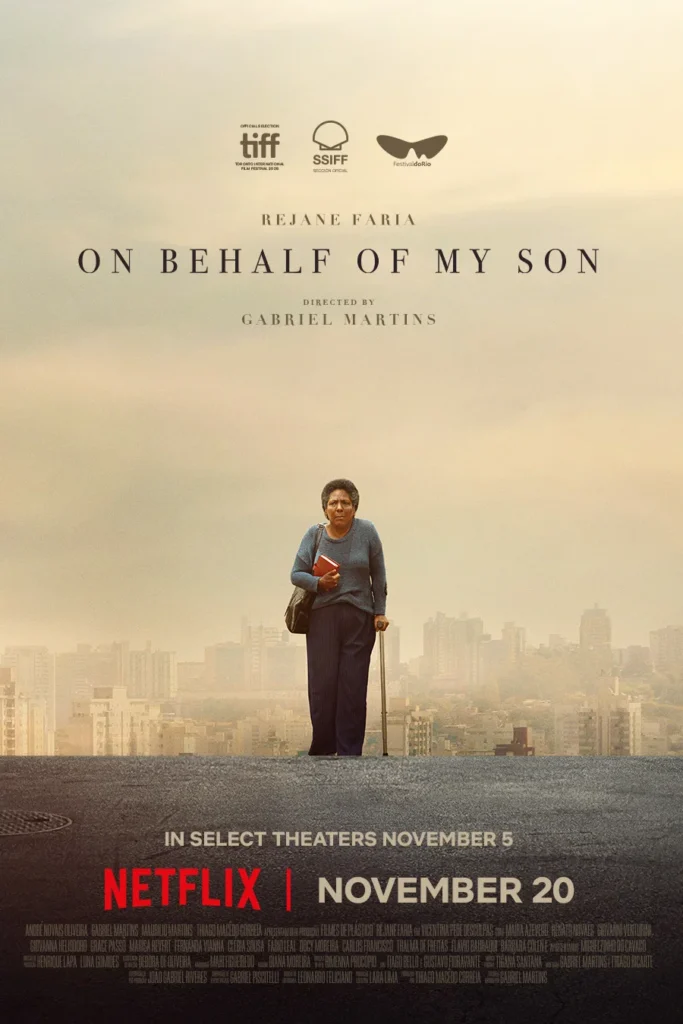
Vicentina’s body is crucial to this experience. She has serious difficulty walking because of a problem with her knee, yet she continues crossing the city, moving slowly from one encounter to another. Her physical struggle gives the journey an almost ritual quality. Every step has weight. Martins does not separate emotional suffering from physical effort: Vicentina’s body itself seems to register the burden she has chosen to carry. Against her slow movement is the chaotic rhythm of a huge city—traffic, noise, work, people rushing from one place to another.
That contrast between individual grief and urban noise is one of the film’s strongest formal ideas. During the Q&A following the film’s world premiere at TIFF, Martins explained that he wanted to place this intensely private story within an environment where people seemingly never have enough time for genuine conversation. Life continues relentlessly around Vicentina. Traffic moves, people work, conversations happen during the length of a cigarette. Against that rhythm, her journey insists upon something increasingly rare: stopping, looking another person in the eye, listening, and remaining present even when the encounter is painful.
Sound therefore becomes especially important. The city is persistently present through traffic, voices, movement, and ambient noise, creating an almost oppressive sonic environment around Vicentina. But Martins gradually changes that relationship between noise and attention. By the film’s final movement, silence itself acquires tremendous force. He described wanting the final shot to create such concentration that one could almost hear a pin drop in the room. This movement from urban noise toward stillness beautifully mirrors Vicentina’s emotional trajectory: the film asks both its characters and its spectators to slow down enough to truly confront another person’s pain.
The performance at the centre of the film is remarkable precisely because it avoids conventional displays of suffering. Vicentina, played by Rejane Faria, is constructed through posture, movement, clothing, breathing, silence, and the way she occupies space. During the Q&A, Faria described developing the character collaboratively with Martins over an extended period, discovering not only how Vicentina should behave, but how she should physically inhabit the world. Martins, in turn, wanted to push a performer he knew personally into a much darker and more physically demanding register than their naturally humorous relationship might suggest.
This physical and emotional precision makes Vicentina an unusually compelling protagonist. She is neither presented simply as another victim nor treated as morally responsible for her son. Instead, she inhabits an uncomfortable position somewhere between guilt and innocence. She cannot undo what he did, cannot restore it, and cannot determine how the families should respond to her. The only thing she can control is the decision to appear before them and say that she is sorry.
The film’s predominantly Black cast and community environment also give the story an important social dimension. Martins allows the characters to inhabit their spaces naturally rather than presenting the community as a sociological backdrop. What emerges is a portrait built through faces, homes, streets, conversations, bodies, and everyday interactions. The sense of belonging is powerful precisely because it is never presented as something that needs to be explained from outside.
Martins has said that the original idea stayed with him for more than a decade. He was fascinated by images in which private mourning became unexpectedly public, and by the possibility of constructing a film around a mother physically going from one home to another in search of forgiveness. What interested him was the collision between something extremely intimate—grief—and the public narratives and judgments that inevitably form around tragedy.
That tension remains at the heart of On Behalf of My Son. Vicentina’s grief belongs to her, but her son’s actions have made it impossible for that grief to remain private. Other people have opinions about him, about what happened, and about what responsibility a mother should carry. Her journey therefore becomes not only an attempt to connect with the victims’ families but also an attempt to reclaim something human from an event that has already been transformed into public judgment.
The English title, On Behalf of My Son, captures one important dimension of that journey, but the Portuguese Vicentina Pede Desculpas may ultimately be even more revealing. The emphasis falls directly on Vicentina and on the action she repeatedly performs: she asks forgiveness. Whether she has the right to do so, whether anyone can accept it, and whether forgiveness is even possible are questions the film wisely leaves to the audience, without offering a clear resolution.
On Behalf of My Son is therefore not really a film about redemption. It is about the far more difficult act of remaining in the presence of pain without knowing how to repair it. Martins builds the film patiently, allowing each encounter to complicate the one before it until Vicentina’s journey becomes both intensely personal and unexpectedly collective. In a contemporary world increasingly characterized by speed, distance, public judgment, and the avoidance of uncomfortable encounters, the film makes the simple act of sitting with another human being feel almost radical.
It is a deeply moving film precisely because it does not pretend that forgiveness can erase tragedy. Sometimes there is no adequate apology, no reconciliation, and no answer. There is only the difficult decision to cross the city, knock on another door, look someone in the eye, and try once again to say: I am sorry.
World Premiere at TIFF2026
The film will be available on November 20 at Netflix
 Rating: 4.5/5