By Colman Hogan
A domestic box-office success and one of the highest rated Chinese films of recent times, Dear You tells a story of how generational memories are created, sustained, and distorted through letter-writing, and of the role writing plays in the transmission of culture and ethnic identity in the overseas ethnic Teochew enclave in Bangkok in the 1950s and 60s, and beyond. The film’s portrayal of this nexus of writing-culture-memory is remarkably suggestive, and, I think, somewhat unique in the history of cinema.
The plot is relayed a-chronologically and concerns approx. 70 years of Chinese/overseas Chinese history. In a nutshell the core plot is the following. Bagsheng, the recently married protagonist who flees China in the late ‘40s under threat of being press-ganged into the Kuomintang, sustains his relationship with his wife for a good dozen years by remitting her money from his meagre salary as a rickshaw driver in Bangkok, and his by loving and optimistic, folk-poetic billets-doux. Unbeknownst to his wife back in China, he is killed in 1960 in a violent altercation attempting to thwart a robbery. However, during his years in Bangkok his simple, idealistic and courageous acts – he starts and finances from his rickshaw salary a school for the local Teochew children to learn Mandarin (even though he himself is partially illiterate and pays a scribe to write his letters home); he, perhaps foolishly, attempts to defend his landlord’s father from thugs who seek to take possession of the inn he owns; and when the thugs burn down the inn he rescues father and daughter from the conflagration, and beats up and maims one of the arsonists, landing him a two year prison sentence – these exploits precipitate the landlord’s daughter, Lamgi, to fall in love with him. This does not happen all at once, however, since Bagsheng’s somewhat cocky and happy-go-lucky attitude rubs Lamgi the wrong way. She is at first a hard-nosed business woman who runs the inn single-handedly, and is rigid on ‘the rules’ as she is determined to succeed and both aware of and above all most cautious about the dangers she and the inn court as a foreign Chinese enclave in Thailand, running an illegal school to boot. She is also privy to the letters Bagsheng writes and receives from his wife, and thus a kind of witness-participant to this epistolary love-affair. When Bagsheng dies, having herself joined the school to learn Mandarin, she continues to finance it and, impersonating Bagsheng, to write and send remittances to Bagsheng’s wife for another 15 or so years.
There is more to the story than this nutshell, including a fair salting of broad comedy, gentle but persistent satire of Thai bribery culture, and a healthy heaping of saccharine smaltz. As Leslie Felperin (The Guardian) writes, “If you train your ears to tune out the sappy instrumental score that accompanies the action [and a fair number of melodramatic scenes]… there’s loads to enjoy here.”
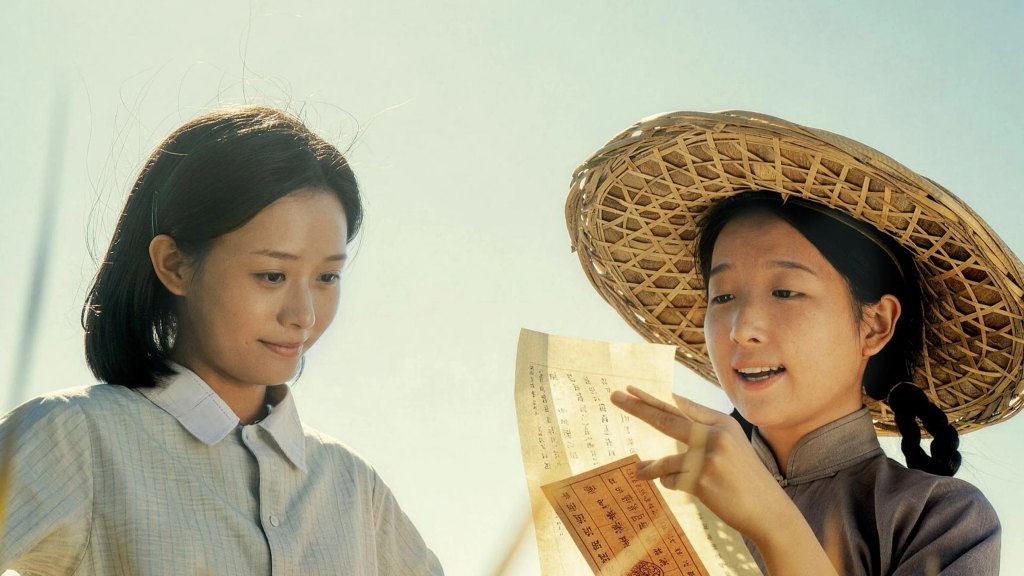
But the most striking thing about the film is its historical point of view, a point of view structured around enormous amnesias. Intertitles throughout the film give us a series of key narrative dates: 1948, 1960, 1978, 2018. In 1948 the KMT hammer on Bagsheng’s door in their campaign of requisitioning every adult male (Bagsheng makes his escape out the back door, never to see his wife again). But the Communist Party is never mentioned in the film (at least in the English subtitles). In 1960 Bagsheng dies, and Lamgi undergoes a crisis: she writes an obituary letter to Bagsheng’s wife, but cannot find the heart to send it and instead continues to remit money from her meagre salary. But the Great Leap Forward and the largest famine in recorded history is never mentioned, nor for that matter the Cultural Revolution. In 1978 Lamgi and her father plan to visit to China to meet Bagsheng’s wife, but her father dies and Lamgi, in more desperate straits, changes her mind. Here there is no mention of the end of the Cultural Revolution, the ascendency of Deng Xiaping to the leadership of the PRC, and the subsequent economic reforms which are the origin of the economic juggernaut that is the PRC today. Finally, in 2018 Bagsheng’s wife makes the trip to Bangkok and meets an aged and semi-senile Lamgi, a ‘long-lost reunion’ of sorts, of the two women who loved Bagsheng. And, once again, an enormous ellipsis, this time of the amendment to the Constitution of the PRC, effectively making Xi Jinping leader for life.
Four world-historical dates and four voidances. In the standard operating procedure and modus operandi of mnemonics, this would be nothing out of the ordinary since memory and forgetting are the two sides of a single sheet of paper. And it goes without saying that a clear conscience usually entails a fuzzy memory. But the enormity of these amnesias – if that is what they are – and the specific gravity of their conjunction, is striking. One is put in mind of Ernst Renan’s famous formulation « tout citoyen français doit avoir oublié la Saint-Barthélemy, les massacres du Midi au XIle siécle ». That one of the most interesting, intricate and nuanced film portrayals of memory-writing in recent years is so structured poses a series of questions of conscious or unconscious intent. Do these voidances constitute an ideological obfuscation, a veiled expression of the ‘noble lie’ of an authoritarian and censorious regime; a ‘writing between the lines’ or esoteric expression of heterodoxy (lest the film be condemned as heretical by the righteous guardians of orthodoxy); or merely a Chinese-communist equivalent of what in another context we would label ‘the Hollywood-commercial imperative’? Adopting a Lacanian idiom we may ask are these the hysterical lapses of an art work (verdrängung : repression), the obsessional displacements (verschiebung) of a religion, or the paranoid foreclosures (verwerfung) of a science? Freud’s contention was that in foreclosure one has actively chosen a position of disbelief, Unglauben, and not merely suffered a failure of faith. Which proposes the question, what is the nature of the Unglauben of the Dear You? A question for sinophiles and sinologists.
Info: Dear You – Imdb