by Hudson Moura
Directed by Allan Deberton, Gugu’s World (Feito Pipa) is a delicate and sensitive coming-of-age drama centred on a young boy whose extraordinary confidence in his own identity contrasts with the difficulties others have in accepting him. Set in the vast, dry landscapes of Ceará, in northeastern Brazil, the film introduces Gugu (Yuri Gomes), a flamboyant, imaginative, and remarkably self-assured child whose exuberance brings unexpected vitality to the austere environment surrounding him.
The film opens to the infectious rhythms of Lady Zu’s 1977 Brazilian disco hit A Noite Vai Chegar, as Gugu dances while getting ready for school. His extravagant, sometimes feminine clothing, combined with a superhero cape, creates a delightful mixture of childhood fantasy and queer self-expression. Against the immense, almost deserted landscapes of the sertão, where drought has stripped the environment of much of its vegetation, Gugu appears almost as an event in himself, filling the emptiness with colour, movement, and imagination.
What makes Gugu particularly compelling is that he does not struggle with his own identity. His femininity is not something he needs to resolve or explain. He has friends, enjoys dancing to Brazilian queer pop icon Pabllo Vittar, and confidently defends himself against the occasional bullying he encounters at school. His happiness and pride are as important to his character as the difficulties he faces. The real problem lies with those who cannot accept him.
A Father Who Cannot Accept His Son
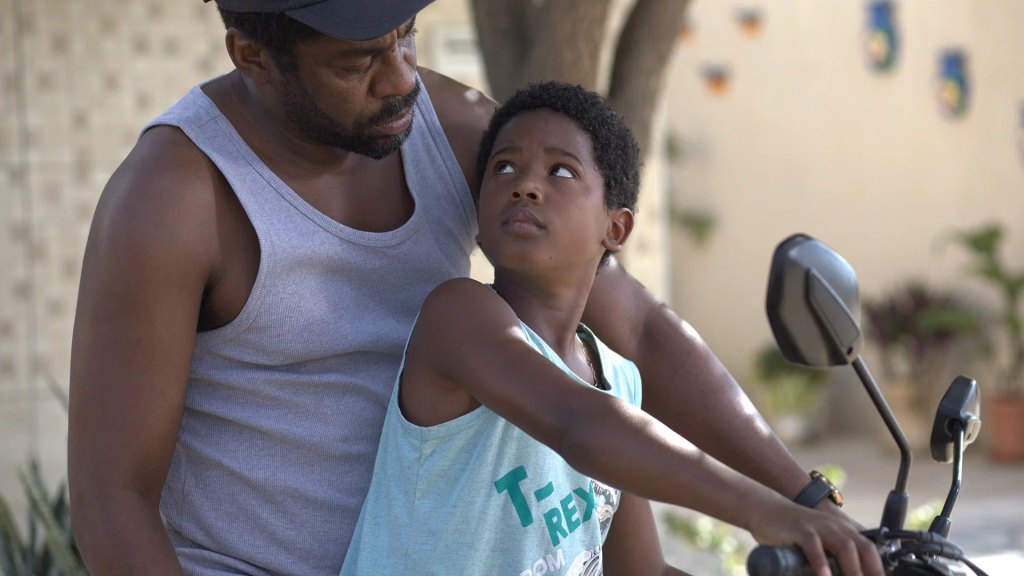
The central emotional conflict emerges through Gugu’s relationship with his father, Batista, played by Lázaro Ramos. A water-truck driver who lives with his new wife and daughters, the father is visibly embarrassed by his son’s femininity and would prefer to see him playing football and conforming to conventional masculine expectations.
Yet their antagonism extends beyond gender. The father seems unable to separate Gugu from the painful memory of his deceased mother, Eliane, while Gugu himself associates his father with that absence. Their resentment becomes so intense that the boy expresses the devastating wish that his father had died instead of his mother.
The film is therefore less about a child discovering who he is than about the emotional boundaries separating people who cannot fully recognize one another. Gugu knows himself remarkably well; it is his father who cannot accept the person standing before him.

The Grandmother, Memory, and a Disappearing Landscape
Gugu lives with his grandmother Dilma (Teca Pereira), whose affection and acceptance provide the security that allows his personality to flourish. But Dilma is gradually losing her memory, confusing past and present and sometimes forgetting even her grandson’s name. For Gugu, her decline threatens the emotional foundation of his freedom.
Her deteriorating memory is closely connected to the history of a reservoir built in the region. Dilma’s daughter Eliane, Gugu’s mother, had protested against its construction and was killed after participating in the resistance. As the water level recedes, remnants of a submerged town—its church, utility poles, and other structures—begin to reappear.
This is one of the film’s most evocative ideas: the landscape gradually reveals its buried past as Dilma loses her ability to distinguish memory from the present. The reservoir becomes an expression of collective loss, political violence, and grief. Cyndi Lauper’s Time After Time, a song loved by Eliane, further connects grandmother, grandson, and the absent mother through music and remembrance.
Deberton builds the film around three distinct personalities—Gugu, Dilma, and the father—whose relationships are defined by boundaries. Dilma’s illness gradually compromises her ability to protect Gugu, while the father remains a more resistant obstacle to his freedom. The central question becomes how far each character can move beyond personal grief, expectations, and emotional limitations to approach the others.
This also gives the Brazilian title, Feito Pipa, its poetic resonance. A pipa is a kite, suggesting childhood, freedom, lightness, and the desire to fly. Yet a kite also depends on the wind and the string connecting it to the ground. Gugu already knows how to fly; what remains uncertain is whether the people holding the string will allow him to continue.
The Sertão: A Landscape Without Its Accent
The contrast between Gugu’s exuberance and the austere landscapes of Ceará is among the film’s strongest visual qualities. The dry expanses, enormous skies, and sparse vegetation create a powerful sense of place, making the boy’s colourful personality even more striking.
However, there is a curious contradiction in the film’s regional identity. Although entirely filmed in Ceará, the actors’ speech rarely reflects the distinctive Ceará accent. Even Gugu’s pronunciation is relatively neutral, while his grandmother and father also speak without the strong regional inflections associated with the sertão.
This matters particularly in a film whose greatest strength is its characters. The Ceará accent is not simply a linguistic detail; it belongs to the region’s cultural landscape as much as its geography. The more generalized Brazilian Portuguese may make the film accessible to a broader national audience, especially with a widely recognized actor such as Lázaro Ramos, but it also diminishes the cultural specificity of its setting. The landscape looks unmistakably regional, yet the voices do not always seem to belong to it.

Beyond Gender Boundaries
One of the film’s greatest achievements is the remarkable construction of Gugu himself. Yuri Gomes brings extraordinary vitality, humour, vulnerability, and honesty to a child whose identity is already remarkably assured. His femininity is neither an internal conflict nor a problem to overcome, but an integral part of his personality. For Gugu, the distinction between what belongs to boys and what belongs to girls simply does not exist. He moves freely between traditionally masculine and feminine forms of expression, without perceiving any contradiction between them. What makes Gugu so remarkable is not that he consciously challenges gender conventions, but that he lives as though those conventions had never existed in the first place. The conflict emerges only when others attempt to impose them upon him.
Yet the film raises an interesting dramatic question: is this remarkable character supported by an equally compelling story? Dilma’s deteriorating memory offers a moving narrative trajectory, while the reservoir introduces a dimension of political and collective memory. Nevertheless, the most powerful conflict remains the relationship between Gugu and his father, because it directly challenges the freedom that defines the boy.
The film’s different narrative strands do not always carry equal dramatic weight. Its sensitivity and attention to character are often more accomplished than its overall narrative construction. But this imbalance also reveals Deberton’s central achievement: rather than forcing Gugu into a conventional story of self-discovery, he allows us to encounter a child whose sense of self is already extraordinarily strong.
Gugu’s World is a moving film about childhood, grief, memory, masculinity, and acceptance. Its most distinctive quality is its refusal to portray queer childhood primarily through confusion or suffering. Gugu knows who he is. The struggle belongs to those around him, especially a father who cannot accept what his son already understands so clearly. Like the kite evoked by its Brazilian title, Gugu brings colour and movement to an unforgiving landscape. His challenge is not to discover how to fly, but to remain free to do so.
Gugu’s World (Feito Pipa), directed by Allan Deberton, has been selected as Brazil’s official submission for Best International Feature Film at the 2027 Academy Awards.
Explore the festival’s complete programme at Brazil Film Fest 2026
 Rating: 4.2/5