by Hudson Moura
Written and directed by Andrew Haigh, A Long Winter follows films such as Weekend (2011), 45 Years (2015), Lean on Pete (2017), and All of Us Strangers (2023), all of which are marked by an interest in intimacy, loneliness, memory, and emotionally fragile relationships. Here, Haigh brings those concerns into a very different setting: a family drama shaped by absence, longing, and the search for someone who is no longer there. Set in the mountains of Colorado and filmed in the Canadian Rockies, the film follows Mike (Fred Hechinger), a young man whose mother disappears during the first blizzard of the season. Her absence gradually forces him to reconsider not only his relationship with his father, played by Ebon Moss-Bachrach, but also his own place within a family already fractured by distance, frustration, and loss.
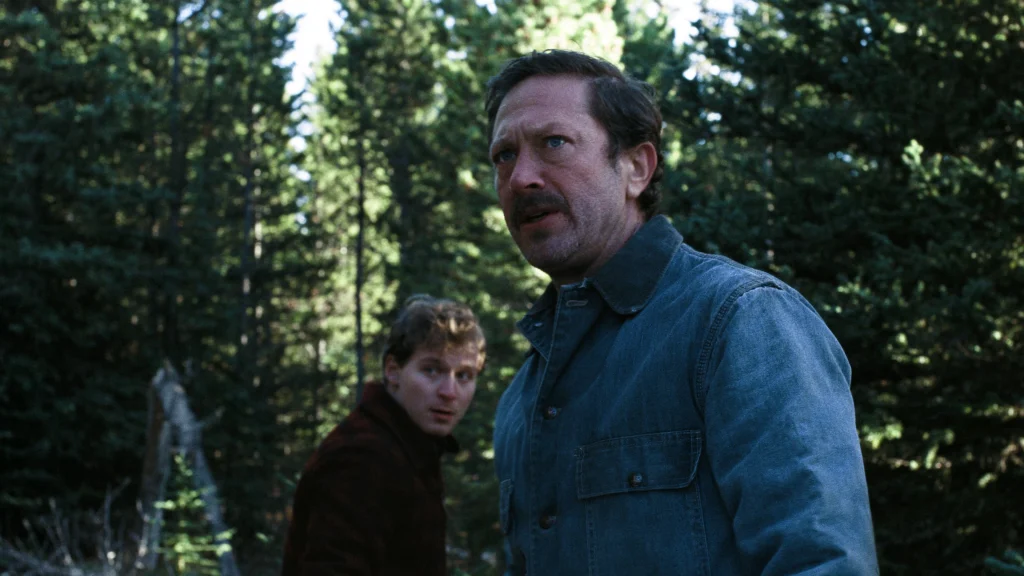
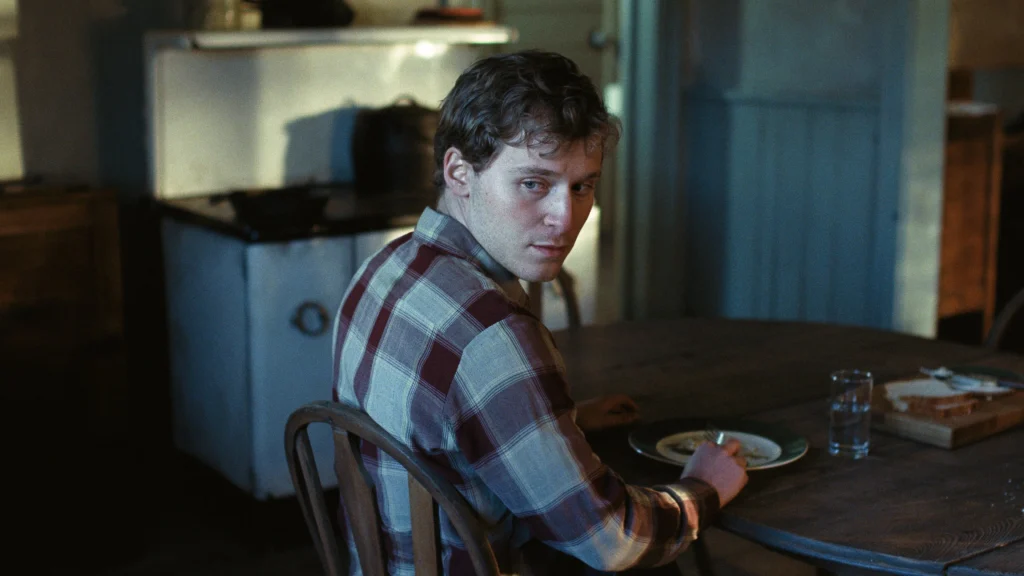
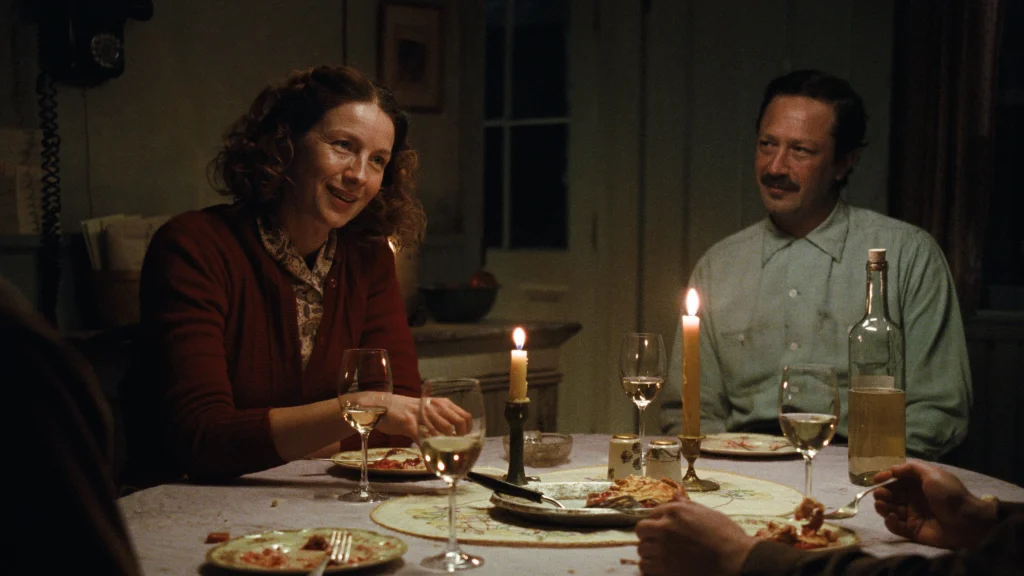
The family lives in an isolated rural environment, surrounded by an immense landscape that becomes one of the film’s strongest elements. The mountains are beautiful but unforgiving, and Haigh uses that vastness to reinforce the emotional distance between the characters. The film was shot by André Turpin, whose photography gives the exterior spaces a striking whiteness and openness, while the interiors of the cabin are often much darker, creating a strong contrast between the exposed landscape outside and the enclosed emotional world of the family.
The family structure is already unstable before the mother disappears. The older brother, played by Kit Connor, leaves for the Korean War, while the mother, played by Caitríona Balfe, is struggling with alcoholism and with a life she clearly never wanted. She had moved there from New York and appears deeply dissatisfied with the isolation of the mountains. Mike, the younger son, seems especially attached to her and often tries to protect her.
When she disappears into the mountains, the film becomes largely a story of searching. Mike refuses to give up hope and continues looking for her even as time passes and the winter becomes harsher. That insistence turns the film into a meditation on longing: not simply the desire to find someone physically, but the desire to understand them more fully once they are gone. In a sense, her absence makes her presence stronger and this experience a striking coming-of-age.
This is perhaps the film’s most interesting emotional idea. Sometimes people become more visible to us only after they disappear. Mike begins to understand his mother differently through the space she leaves behind, and the search becomes as much about memory and self-identity as it is about finding her. The environment plays into this beautifully: the landscape seems to absorb her absence, making the mountains feel almost like another character.
Yet for all of its visual strength, the film often feels too familiar. The narrative of a broken family, an alcoholic mother, an emotionally distant father, and a son trying to hold everything together has been explored many times before. Haigh approaches the material with sensitivity, but there is little in the storytelling that feels genuinely surprising or dramatically new.
This is particularly frustrating because so many of the film’s individual elements are strong. The casting is excellent, the production is accomplished, and the cinematography is often remarkable. Shot by André Turpin, whose previous work includes some of the most visually memorable Canadian films of the past 25 years, such as Incendies, Mommy, and Maelström, the film makes particularly effective use of the snowy landscapes and the contrast between the bright expanses of the mountains and the darker interiors. The visual world is consistently more distinctive than the drama itself.
The soundtrack, however, is less convincing. It is often heavy and too insistent for a film that otherwise depends on quiet, distance, and emotional restraint. Rather than deepening the atmosphere, the music sometimes seems to push the viewer toward feelings the images and performances are already capable of expressing on their own.
The result is a film that feels technically assured but dramatically underpowered. It has the actors, the location, the production values, and the visual language of a major emotional drama, but it often seems to be waiting for a stronger script or a more inspired dramatic turn.
Still, A Long Winter works best when it focuses on the fragile relationship between Mike and his father, and on the strange intimacy created by the mother’s absence. The film understands that grief is not only about loss, but about the way absence forces people to re-evaluate those they thought they knew.
Ultimately, A Long Winter is a beautifully crafted and emotionally sincere film, but also a somewhat conventional one. Its photography and setting are much more memorable than its narrative, and while the story explores longing with sensitivity, it never quite reaches the emotional or dramatic force suggested by its remarkable visual world.
 Rating: 3/5