by Hudson Moura
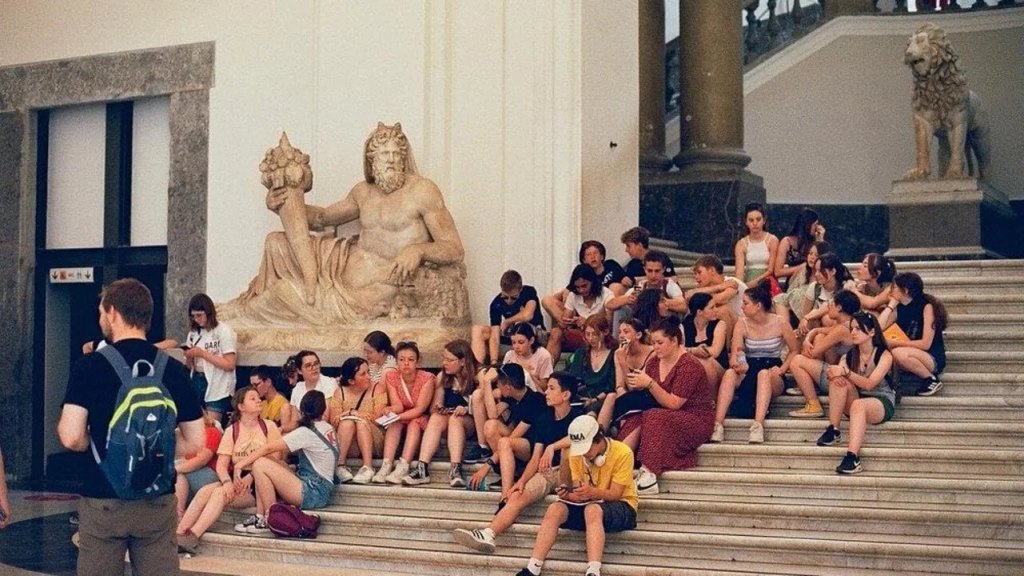
Written and directed by Marine Atlan, La Gradiva is a French coming-of-age film following a group of high-school students on a school trip to Pompeii, where ancient ruins, museums, religious processions, and discussions about art and history provide the setting for a much more intimate exploration of adolescence. At its centre are Toni and James, two extremely close friends. Neither seems to understand exactly what they are to each other, and Atlan wisely never defines the relationship for them. Their feelings remain suspended somewhere between friendship, attraction, rivalry, and desires they cannot yet name.
Adolescence, Desire, and Social Performance
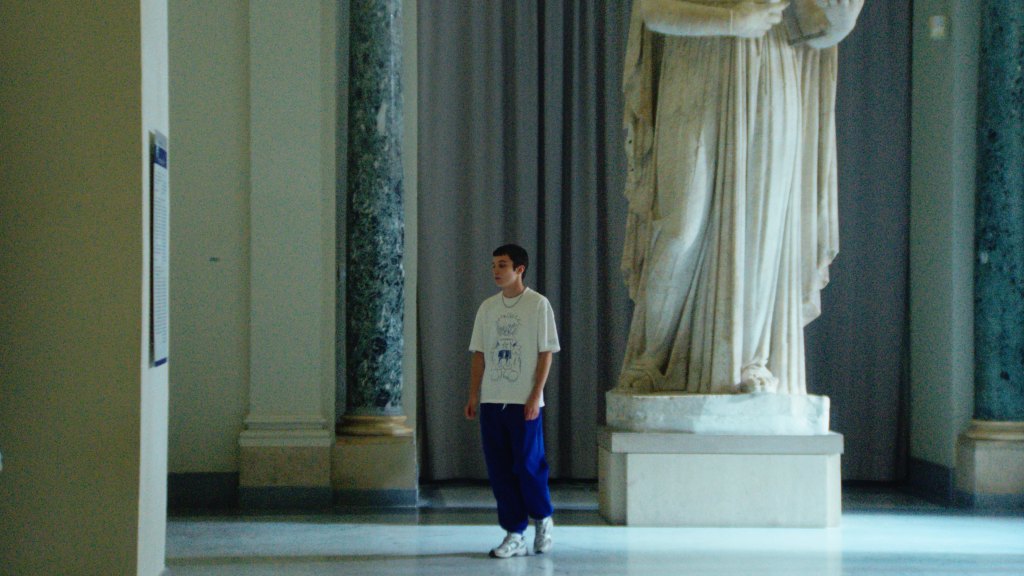
Toni and James drift through the ruins, museums, and lectures with almost complete detachment from the educational purpose of the trip. They mock their teacher, make fun of other students, and are repeatedly reprimanded. Yet Atlan never reduces their behaviour to simple adolescent indifference. James, played by Mitia Capellier-Audat, cultivates the posture of the reserved intellectual, while Toni, played by Colas Quignard, is the disruptive one, constantly trying to impose himself and attract the group’s attention. But Toni also has unexpected moments of contemplation and solitude that complicate the provocative persona he performs for everyone else.
Suzanne, played by Suzanne Gerin, provides their counterpoint. Shy, somewhat isolated from the group, and genuinely engaged with the lessons and discussions, she says relatively little but watches the others intensely. The tensions among Suzanne, James, and Toni gradually give the film much of its charge, although their desires do not necessarily point toward one another. James sleeps with girls who cross his path seemingly without consequence; Toni drifts through encounters arranged on dating apps; while Suzanne conceals an attraction toward one of her female classmates, a desire she is unable to express openly. At the same time, she looks critically at Toni and James and despises the way they treat women. Sexual freedom, repression, attraction, and judgment circulate throughout the group without settling into a conventional romantic triangle.
The adults are not merely background figures. Mme Mercier, the Latin teacher, played by Antonia Buresi, gradually becomes another of the film’s pivotal characters. Twenty years into a profession that has exhausted her, without children and living alone, she slowly draws part of the story toward her own experience. Rather than simply positioning her as the authority against which Toni and James rebel, Atlan reveals the fatigue and solitude behind that authority. Her gaze and Suzanne’s are among the most penetrating in the film: both women observe the people and spaces around them with a patience and attention that contrast with the boys’ more demonstrative behaviour.
Education, Class, and Authority
Atlan also allows the French educational system to enter the film through the students themselves. They argue about teachers, strikes, discipline, authority, and what they perceive as the deterioration of education. One bourgeois student complains that teachers do not make enough effort, strike too frequently, and have lost control of badly behaved students, leaving them to spend more time imposing discipline than actually teaching. He even argues that disruptive students (like Toni) should be placed in vocational programs rather than allowed to disturb everyone else. Atlan lets this discourse unfold without imposing an explicit conclusion, allowing questions of class, authority, education, and social division to emerge from the students themselves.
Pompeii, Gradiva, and the Return of the Repressed
Toni’s relationship with Pompeii introduces another, more personal layer. His grandmother, Angelica, came from the Naples region, and her turbulent and somewhat confusing past connects the trip to his own search for his Italian roots. For someone who spends so much of the film performing indifference, being physically present in the landscape of his family history produces moments of recognition and contemplation that he cannot easily articulate. The ruins, museums, streets, and people therefore never function merely as picturesque scenery; they become part of Toni’s attempt to understand where he comes from.
The title provides the key to understanding how deeply Atlan connects this landscape to the inner lives of her characters. La Gradiva points to Wilhelm Jensen’s 1903 novella Gradiva, which Freud famously interpreted through the idea of repression, with Pompeii becoming a landscape in which what has been buried returns to the surface. Atlan makes that echo explicit. During a class among the ruins, Mme Mercier leads the students through the symbolism of a painting and of Vesuvius’s eruption before asking them to write a reflection paper. Toni begins his text: “The cloud of smoke filled my head and the noise wouldn’t stop.” His writing moves through gas, ash, shaking ground, and screaming crowds—a catastrophe arriving all at once and leaving devastation behind. But what initially sounds like an imaginative response to Pompeii gradually becomes something much more personal.
Toni’s text turns into an accusation. No one told him that this country and this history were also his, and he vows not to hide anything about what he has seen. There is something strangely soothing for him in confronting this truth, even as he acknowledges that he knows no one there. The text begins to read almost like a letter to his mother. Pompeii’s buried city becomes connected to his own family’s buried Italian past: archaeology turns into a metaphor for recovering an identity and history that were never properly transmitted to him.
And Toni is hardly the only character excavating something buried. Repression runs throughout La Gradiva. James seeks physical and sexual contact easily but remains incapable of expressing what he actually feels. Suzanne’s attraction toward a female classmate, hidden in her everyday interactions, surfaces more freely in her dreams among the ruins. Mme Mercier also becomes implicated in this circulation of suppressed desire when James attempts to approach her intimately, bringing feelings to the surface that she must repress. In each case, something that cannot be openly articulated finds another way to emerge.
Family histories, sexual desires, loneliness, attraction, and resentment exist beneath the surface like the city itself. This relationship between archaeology and repression becomes one of the film’s richest ideas. Pompeii is not simply a place where these characters happen to spend a few days; its buried past provides a metaphor for their emotional lives. The trip gradually becomes a process of excavation, although Atlan is careful never to suggest that everything buried can—or should—be completely uncovered.
Bodies, Silences, and Cinematic Space
This is also where La Gradiva is particularly accomplished as cinema. Much of what matters is communicated not through explanation but through looks, gestures, bodies, silences, dreams, and the way the characters occupy cinematic space. Atlan does not require her young characters to understand themselves completely because their confusion is precisely part of the film’s subject. Attraction can coexist with hostility; sexual experience does not necessarily produce emotional maturity; arrogance can suddenly reveal vulnerability; and apparent detachment can conceal an intense desire to be seen.
The naturalness of the young performers is essential to this effect. Remarkably, these are their first film roles, yet they rarely seem to be performing in any conventional sense. Colas Quignard is particularly impressive as Toni, displaying an assurance and physical presence that suggest a far more experienced actor. Mitia Capellier-Audat and Suzanne Gerin are equally convincing, to the point that all three seem less to be interpreting characters than temporarily becoming them. Atlan builds scenes around small reactions and gestures rather than dramatic declarations.
That combination of young performers, physical presence, everyday gestures, social tensions, and desires the characters themselves cannot fully formulate reminded me of the adolescent universe of Abdellatif Kechiche’s Games of Love and Chance (L’Esquive). The connection is less narrative than cinematic: that particular capacity to make behaviour itself dramatic and to allow characters to emerge through bodies, language, looks, and interactions rather than through conventional psychological explanation.
La Gradiva is a strong, uncomfortable, and demanding film, and it earns that discomfort. Atlan observes young people caught between desire and indifference, rebellion and contemplation, sexual experimentation and repression, while an exhausted teacher confronts both another generation and her own solitude. Pompeii ultimately becomes much more than the location of their school trip. It provides the film with its central metaphor: what has been buried does not necessarily disappear. Toni searches through a family history that was withheld from him; James acts on desire while struggling to articulate emotion; Suzanne’s hidden same-sex desire emerges through dreams; and Mme Mercier confronts feelings that cannot be acted upon.
Like the ancient city surrounding them, each character seems to carry a buried world. What makes La Gradiva so distinctive is Atlan’s refusal to excavate those worlds completely for us. The film moves through these layers of desire, memory, identity, and repression with remarkable subtlety, allowing gestures, silences, dreams, bodies, and gazes to carry as much meaning as words. What lies beneath the surface—and what may eventually emerge from it—becomes the film’s central tension.
 Rating: 4.4/5
Film Info: La Gradiva – Imdb — TIFF2026