by Hudson Moura
Written and directed by Ira Sachs and co-written by his longtime collaborator Mauricio Zacharias, The Man I Love continues a creative partnership that has shaped several of Sachs’s previous films, including Keep the Lights On (2012), Love Is Strange (2014), Little Men (2016), Frankie (2019), and Passages (2023). Here, however, Sachs turns toward a more overtly theatrical structure, building the film around the rehearsals of a play and the fragile lives of the actors performing it.
The film’s most interesting idea is the role of rehearsal itself. The actors repeat scenes, gestures, lines, and emotional beats, constantly trying to refine them and get closer to something more truthful. Outside the theatre, however, life offers no such possibility. It cannot be repeated, corrected, or perfected. That contrast becomes particularly powerful through the film’s main character, Jimmy George, played by Rami Malek, who is living with AIDS and for whom the play may represent one of his final experiences on stage. Rehearsal therefore acquires a different emotional weight: it is no longer simply about perfecting a performance, but about time, mortality, and the desire to hold on to something that is already slipping away.
Sachs is clearly interested in the point where theatre and intimate life begin to overlap. The actors’ private experiences gradually interfere with the way they perform, while the artificial space of rehearsal becomes a place where very real emotions are exposed. The film keeps asking what repetition means when the people repeating these scenes are themselves changing, suffering, and moving toward situations they cannot control.
There is also an important dialogue with Michel Tremblay’s theatrical universe and with Il était une fois dans l’Est, the 1974 film directed by André Brassard. During the TIFF Q&A, Sachs spoke about discovering Brassard’s work after being introduced to it in Toronto through Inside Out Film Festival, an encounter that would later inform this film. That influence is particularly meaningful because The Man I Love is not simply interested in bringing theatrical material to the screen; it explores the tension between theatre and cinema, performance and reality, repetition and spontaneity—between gestures and words rehearsed until they achieve precision and the unpredictable experiences of life that inevitably enter, disrupt, and transform the performance.
That creates an intriguing paradox in Sachs’s own directing method. He has described his preference for capturing a first response from actors and avoiding conventional rehearsal before filming, yet The Man I Love is structured around rehearsal as its dramatic engine. The contrast is fascinating because the film itself becomes an exploration of what rehearsal can reveal, even as Sachs’s filmmaking process apparently seeks freshness and immediacy.
The New York setting also plays an important role. Sachs is drawn to the small, fleeting details of everyday life, and the film often feels less interested in creating a grand historical statement than in capturing temporary moments between people. The theatre belongs to that same urban world: artistic, fragile, communal, and impermanent. What matters is not only the play being rehearsed, but the sense that this specific combination of people, emotions, spaces, and circumstances will never exist again in exactly the same way.
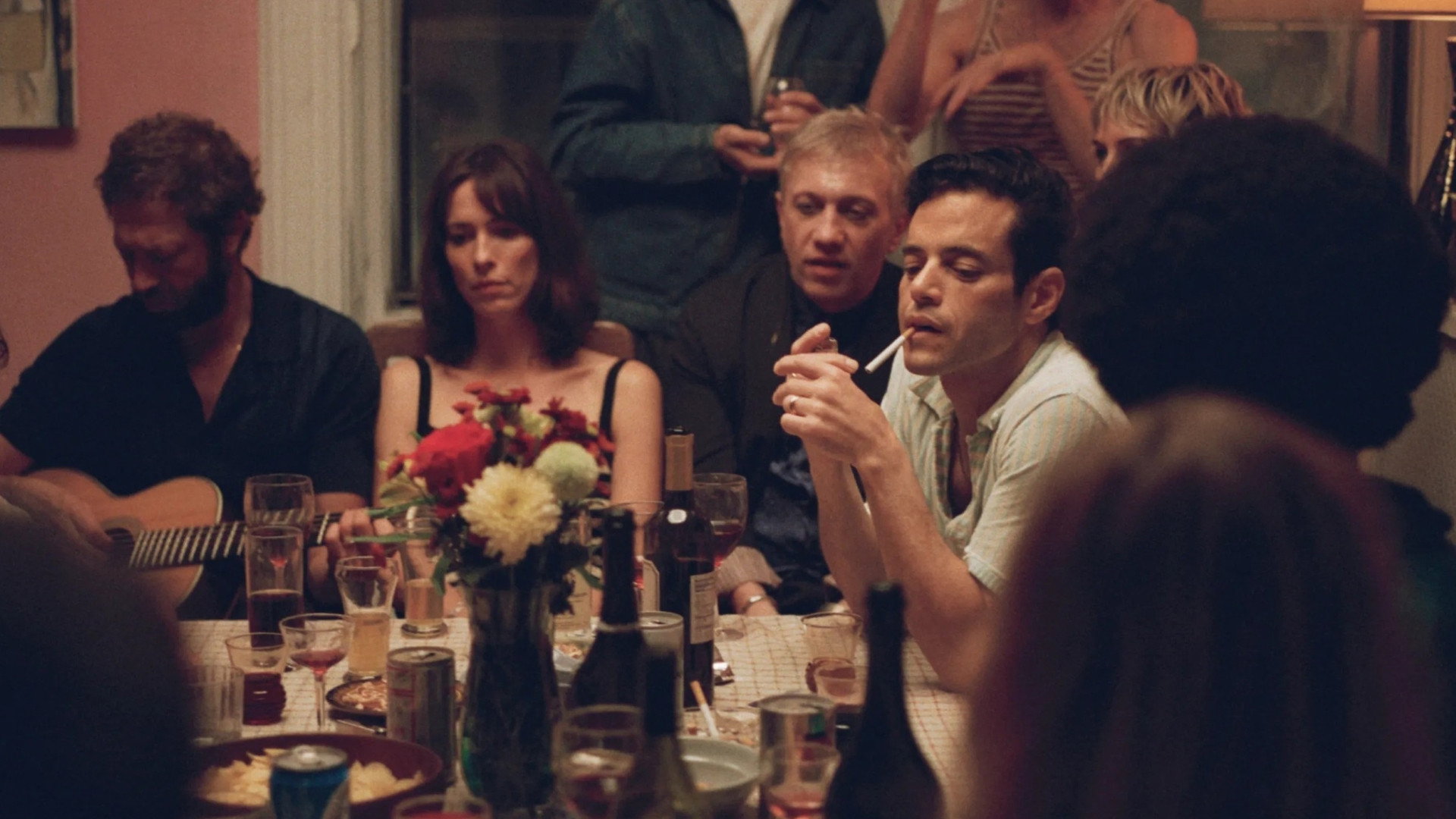
At the same time, this is where some of my reservations begin. The idea of rehearsal is rich, but the screenplay does not always transform repetition into genuine dramatic progression. Some scenes feel less like variations that deepen the characters than like repetitions that simply restate what has already been established. The film understands rehearsal conceptually, but does not always make it dramatically cumulative.
The AIDS context also places The Man I Love within a familiar historical territory of queer cinema, returning once again to the 1980s and 1990s and to the early devastation of the epidemic. That period remains historically and emotionally essential, but the film sometimes feels caught between the intimacy of its theatrical structure and the larger weight of the history it invokes.
The emotional effect therefore becomes somewhat uneven. The material should be profoundly moving, and there are moments when the contrast between performance, illness, memory, and mortality is genuinely affecting. But the film does not always achieve the dramatic intensity its premise seems to promise.
This is compounded by Rami Malek’s performance, which I did not find entirely convincing, relying too heavily on mannerisms that sometimes draw attention to the performance itself rather than to Jimmy George. Given how much the film depends on vulnerability and emotional precision, this distance becomes particularly noticeable. The theatrical setting asks us to believe both in Jimmy as a character and in his relationship to performance, but that fusion never feels entirely achieved.
Still, The Man I Love contains a beautiful cinematic idea at its core: on stage, a scene can be repeated until it feels right; in life, there are no second takes. Sachs uses theatre to think about mortality, love, artistic creation, and the fleeting nature of human experience. The result is thoughtful and often delicate, even if the screenplay and performances do not always give the concept the dramatic force it deserves.
Ultimately, The Man I Love is most compelling as a reflection on repetition, performance, and impermanence. Its theatrical framework, its dialogue with Michel Tremblay and André Brassard, and its intersection of art and private life give the film real conceptual richness. But the very structure that makes it distinctive also becomes its limitation: too often, repetition remains repetition rather than transformation.
 Rating: 3.5/5