by Hudson Moura
Written and directed by Javier Calvo and Javier Ambrossi, La Bola Negra unfolds across different generations of Spanish history, gradually revealing its connection to an unfinished project by Federico García Lorca. The screenplay also draws on Alberto Conejero’s play La piedra oscura, adding another literary layer to the film’s exploration of homosexuality, repression, memory, and queer experience across time. Once the connection to Lorca emerges, his fragment becomes an important key to understanding the film’s larger project. The film treats Lorca not simply as a literary reference, but as a symbolic point of origin: his homosexuality, his artistic freedom, and the violence of the society in which he lived become echoes that continue through the lives of later characters.
This generational structure is one of the film’s most ambitious ideas. Rather than constructing a conventional biographical drama around Lorca, Calvo and Ambrossi use both Lorca’s unfinished work and Conejero’s theatrical text as points of departure for moving through different historical moments. In this sense, La Bola Negra becomes less about Lorca himself than about the persistence of queer memory and the ways in which that memory is transmitted, reinterpreted, and transformed across generations.
The directors clearly approach the material as a love letter to poetry, art, theatre, and cinema. The film is visually elaborate, theatrical, emotionally heightened, and deeply invested in the transformative power of artistic expression. During the TIFF Q&A, Calvo and Ambrossi, joined by cast members Guitarricadelafuente, Miguel Bernardeau, Carlos González, Milo Quifes, and Penélope Cruz—whom the directors described as the project’s “godmother”—spoke about cinema as an art form capable of transforming the spectator. That ambition is evident throughout the film. It is therefore easy to understand why Calvo and Ambrossi received the Best Director award at Cannes: the mise-en-scène is consistently inventive, flamboyant, and formally ambitious.

Yet this is also where my main reservation begins. The film’s direction is considerably stronger than its screenplay. The movement between different historical periods, literary references, and characters is not always clear, and the transitions can become confusing. The ambition of covering such a broad historical, cultural, and emotional territory sometimes works against the narrative itself. Rather than allowing each generation to acquire its own complexity, the film occasionally moves too quickly between symbolic moments, characters, and historical references. Some of these connections may be more immediately legible to a Spanish audience already familiar with Lorca, Conejero, and the broader cultural context, but for international viewers they can make the narrative feel unnecessarily fragmented.
More importantly, I found its representation of gay experience unexpectedly familiar. La Bola Negra traces almost a century of homosexuality, yet its dominant vocabulary remains suffering, rejection, secrecy, violence, and tragedy. That perspective is entirely understandable when dealing with García Lorca and the historical persecution of homosexuality in Spain, and that memory cannot—and should not—be erased. The limitation appears when the film reaches more contemporary generations and still struggles to imagine many alternatives to that same tragic framework. After travelling so far historically, I would have liked it to open toward other possibilities: different ways of being gay, loving, building a life, and inhabiting sexuality beyond persecution and loss.
This creates an interesting paradox. La Bola Negra is formally daring but thematically more conventional than it initially appears. Its visual language constantly searches for new forms, yet its understanding of queer experience repeatedly returns to a narrative cinema has already explored extensively: homosexuality as suffering. That does not diminish the film’s emotional sincerity. There is something genuinely moving in the directors’ attempt to acknowledge those who came before, particularly generations who were never able to live openly. The film’s engagement with grandparents, inheritance, memory, and the desire to recover lives that previous generations could not fully express gives it a strong emotional foundation, with Lorca’s unfinished text becoming part of a much larger unfinished history.
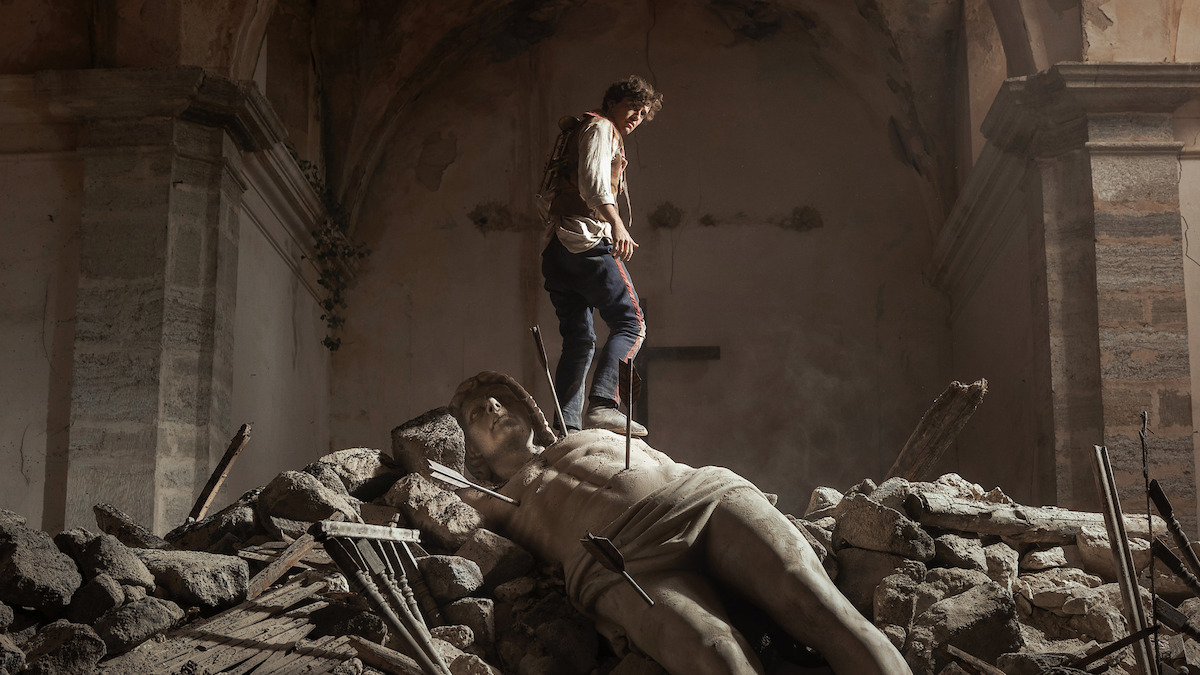
Interestingly, my difficulty following parts of the storyline does not seem to have prevented the film from connecting strongly with audiences. La Bola Negra was warmly received at TIFF, where it won a People’s Choice Award, suggesting that its emotional and visual impact outweighed any narrative confusion for many viewers. That response is understandable: the film is passionate, visually expressive, and built around themes of memory, love, art, and historical injustice that resonate well beyond its specifically Spanish context.anish context.
Ultimately, La Bola Negra is a film I admire more for how it tells its story than for the story it ultimately chooses to tell. Calvo and Ambrossi create an audacious cinematic structure from Lorca’s unfinished project, Alberto Conejero’s La piedra oscura, and a broader archive of queer Spanish memory, transforming them into a multi-generational meditation on homosexuality, art, repression, and remembrance. But despite its extraordinary visual ambition, the screenplay remains uneven and its portrait of homosexuality too often confined to suffering and tragedy.
Following its theatrical release on October 23, La Bola Negra is scheduled to begin streaming on Netflix on December 2.
 Rating: 4.2/5