By Hudson Moura
Tristan Séguéla’s The Good Lawyer (Un bon avocat) is a fast-paced, colourful, and thoroughly entertaining comedy-drama that rarely slows down. Driven by Laurent Lafitte’s charismatic performance, the film follows the spectacular downfall of a successful but deeply compromised lawyer whose addictions and questionable professional practices threaten to destroy his career. What makes the film particularly engaging, however, is not simply his struggle to recover, but the unexpected relationship that develops between two men with radically different attitudes toward the legal profession.
Maître Landry (Laurent Lafitte) is a lawyer who has built his career defending criminals and fraudsters, motivated primarily by money and the lifestyle it affords him. Addicted to alcohol and cocaine, he has long abandoned any meaningful sense of professional responsibility. His downfall comes dramatically when he suffers an overdose in the middle of a courtroom hearing, exposing his addictions and misconduct to everyone present. Following three weeks in rehabilitation, Landry faces the possibility of imprisonment and, perhaps more devastatingly, the permanent loss of his right to practise law.
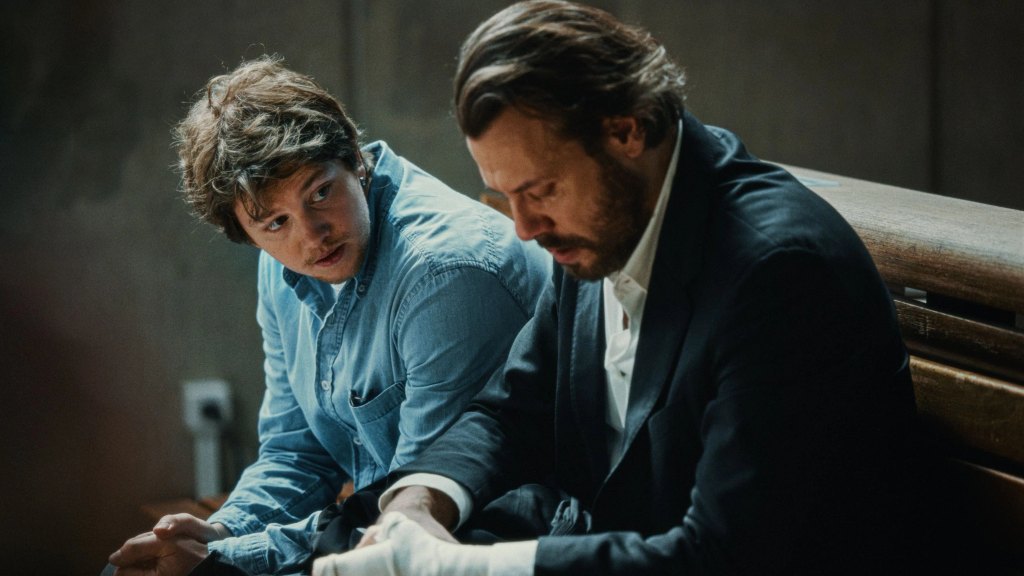
At his lowest point, he encounters Noé (Anthony Bajon), an aspiring lawyer in his thirties who has struggled unsuccessfully to secure an internship. For Noé, Landry represents a last opportunity to enter the profession. Yet the irony of their encounter quickly becomes apparent: while Noé believes he needs Landry’s professional guidance, it is Landry who desperately needs someone to help him rebuild his life.
An Unlikely Partnership and a Question of Morality
Their unlikely partnership becomes the film’s central strength. Noé gradually helps Landry regain his footing, accompanying him through the complicated world of former clients, dubious associates, and questionable legal arrangements. But Landry’s recovery is far from a conventional story of redemption. He does not suddenly become an exemplary lawyer after rehabilitation. He continues manipulating situations, defending dubious characters, and exploiting legal loopholes to protect himself and preserve his career.
This is where The Good Lawyer becomes particularly interesting. Noé serves as Landry’s moral counterpoint, constantly questioning his decisions and challenging his understanding of professional responsibility. Landry possesses the experience, knowledge, and skills that Noé desperately wants to acquire, but he has lost the ethical conviction that initially gives a profession its meaning. Noé, by contrast, lacks experience but retains an almost idealistic belief in the value of becoming a lawyer.
Lafitte is particularly effective in making Landry an unexpectedly sympathetic protagonist. Despite his dishonesty, compulsive behaviour, and morally questionable choices, he remains remarkably charismatic. The audience finds itself rooting for him, hoping his schemes will succeed even when his actions are difficult to defend. This contradiction between moral judgment and emotional identification is one of the film’s most entertaining qualities. We want Landry to succeed, regardless of whether he deserves to.
A Roller-Coaster Comedy with a Professional Conscience
Séguéla maintains an energetic rhythm throughout, moving rapidly between professional crises, personal setbacks, and increasingly complicated situations. The film unfolds almost like a roller coaster, with little room for dull moments. Although certain situations and character developments occasionally rely on familiar conventions, the lively storytelling and engaging performances prevent these clichés from undermining the entertainment.
Ultimately, the film’s title raises a deceptively simple question: What does it mean to be a good lawyer? Is professional success measured by the ability to win cases, manipulate the law, and protect clients at any cost? Or does it require a commitment to principles that extend beyond personal ambition?
What makes Noé particularly inspiring is his determination to pursue a profession that Landry has gradually learned to exploit rather than respect. Their relationship illustrates how someone entering a profession with enthusiasm and conviction can challenge a more experienced colleague who has lost faith in its purpose.
The Good Lawyer does not offer a straightforward account of moral redemption. Instead, it presents an amusing and engaging portrait of professional ambition, ethical compromise, and the possibility of rediscovering the meaning of one’s work. With its energetic direction, charismatic performances, and consistently entertaining narrative, Séguéla delivers a film that is both enjoyable and surprisingly thoughtful.
The Good Lawyer is available to stream on Netflix.
Info: The Good Lawyer (Un bon avocat, 2026) – Imdb